



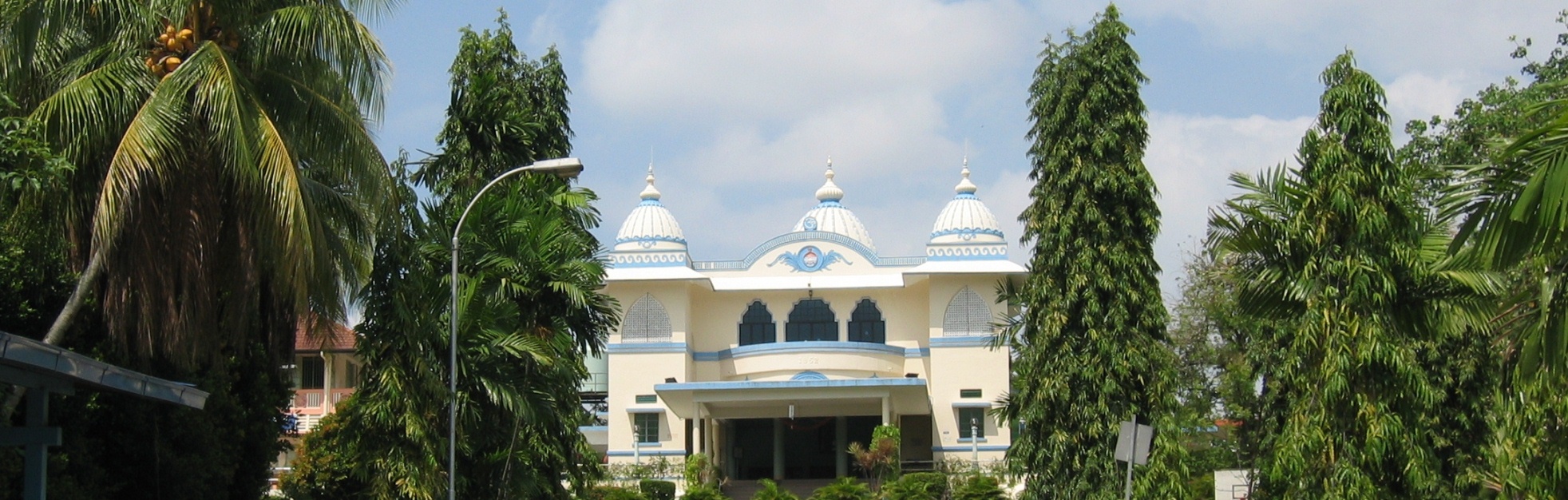
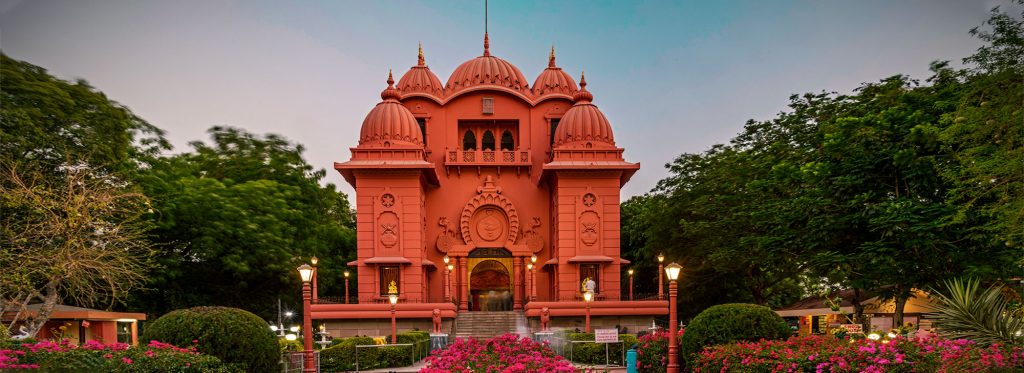
Ramkrishna Mission
Ramakrishna Mission (RKM) is a Hindu religious and spiritual organisation which forms the core of a worldwide spiritual movement known as the Ramakrishna Movement or the Vedanta Movement. The mission is named after and inspired by the Indian saint Ramakrishna Paramahamsa and founded by Ramakrishna’s chief disciple Swami Vivekananda on 1 May 1897. The organisation mainly propagates the Hindu philosophy of Vedanta–Advaita Vedanta and four yogic ideals– Jnana, Bhakti, Karma, and Raja yoga.
Apart from religious and spiritual teaching, the organisation carries out extensive educational and philanthropic work in India and abroad. This aspect came to be a feature of many other Hindu movements. The mission bases its work on the principles of karma yoga, the principle of selfless work done with a dedication to God. The Ramakrishna Mission has centres around the world and publishes many important Hindu texts. It is affiliated with the monastic organization. Vivekananda was greatly influenced by his guru (teacher) Ramakrishna.
Overview
The Math and the Mission are the two key organisations that direct the work of the socio-spiritual-religious Ramakrishna movement, influenced by 19th-century (1800-1900) saint Ramakrishna Paramahamsa and founded by his chief disciple Vivekananda. Also referred to as the Ramakrishna Order, the Math is the movement’s monastic organisation. Founded by Vivekananda in 1897, the Math primarily focuses on spiritual training and the propagation of the movement’s teachings.
The Mission, founded by Vivekananda in 1897, is a humanitarian and spiritual organisation which carries out medical, relief and educational programs. Both the organisations have headquarters at the Belur Math. The Mission acquired a legal status when it was registered in 1909 under Act XXI of 1860. Its management is vested in a Governing Body. Though the Mission with its branches is a distinct legal entity, it is closely related to the Math. The elected trustees of the Math also serve as Mission’s Governing Body. Vedanta Societies comprise the American arm of the Movement and work more in purely spiritual field rather than social welfare.
History
Ramakrishna Paramahamsa (1836–1886), regarded as a 19th-century mystic, was the inspirator of the Ramakrishna Order of monks and is regarded as the spiritual founder of the Ramakrishna Movement. Ramakrishna was a priest in the Dakshineswar Kali Temple and attracted several monastic and householder disciples. Narendranath Dutta, who later became Vivekananda was one of the chief monastic disciples. According to Vrajaprana, shortly before his death in 1886 Ramakrishna gave the ochre cloths to his young disciples, who were planning to become renunciates. Ramakrishna entrusted the care of these young boys to Vivekananda. After Ramakrishna’s death, the young disciples of Ramakrishna gathered and practised spiritual disciplines. They took informal monastic vows on a night of 24 December 1886.
After the death of Ramakrishna in 1886, the monastic disciples formed the first Math (monastery) at Baranagore. Later Vivekananda became a wandering monk and in 1893 he was a delegate at the 1893 Parliament of the World’s Religions. His speech there, beginning with “Sisters and brothers of America” became famous and brought him widespread recognition. Vivekananda went on lecture tours and held private discourses on Hinduism and spirituality. He also founded the first Vedanta Society in the United States at New York. He returned to India in 1897 and founded the Ramakrishna Mission on 1 May 1897. Though he was a Hindu sadhu and was hailed as the first Hindu missionary in modern times, he exhorted his followers to be true to their faith but respect all religions of the world as his guru Ramakrishna had taught that all religions are pathways to God. One such example is his exhortion that one can be born in a church but he or she should not die in a church meaning that one should realise the spiritual truths for themselves and not stop at blindly believing in doctrines taught to them. The same year, famine relief was started at Sargachi by Swami Akhandananda, a direct disciple of Ramakrishna. Swami Brahmananda, a direct disciple of Ramakrishna, was appointed as the first president of the Order. After the death of Vivekananda in 1902, Sarada Devi, the spiritual counterpart of Ramakrishna, played an important role as the advisory head of a nascent monastic organisation. Gayatri Spivak writes that Sarada Devi “performed her role with tact and wisdom, always remaining in the background.”


