



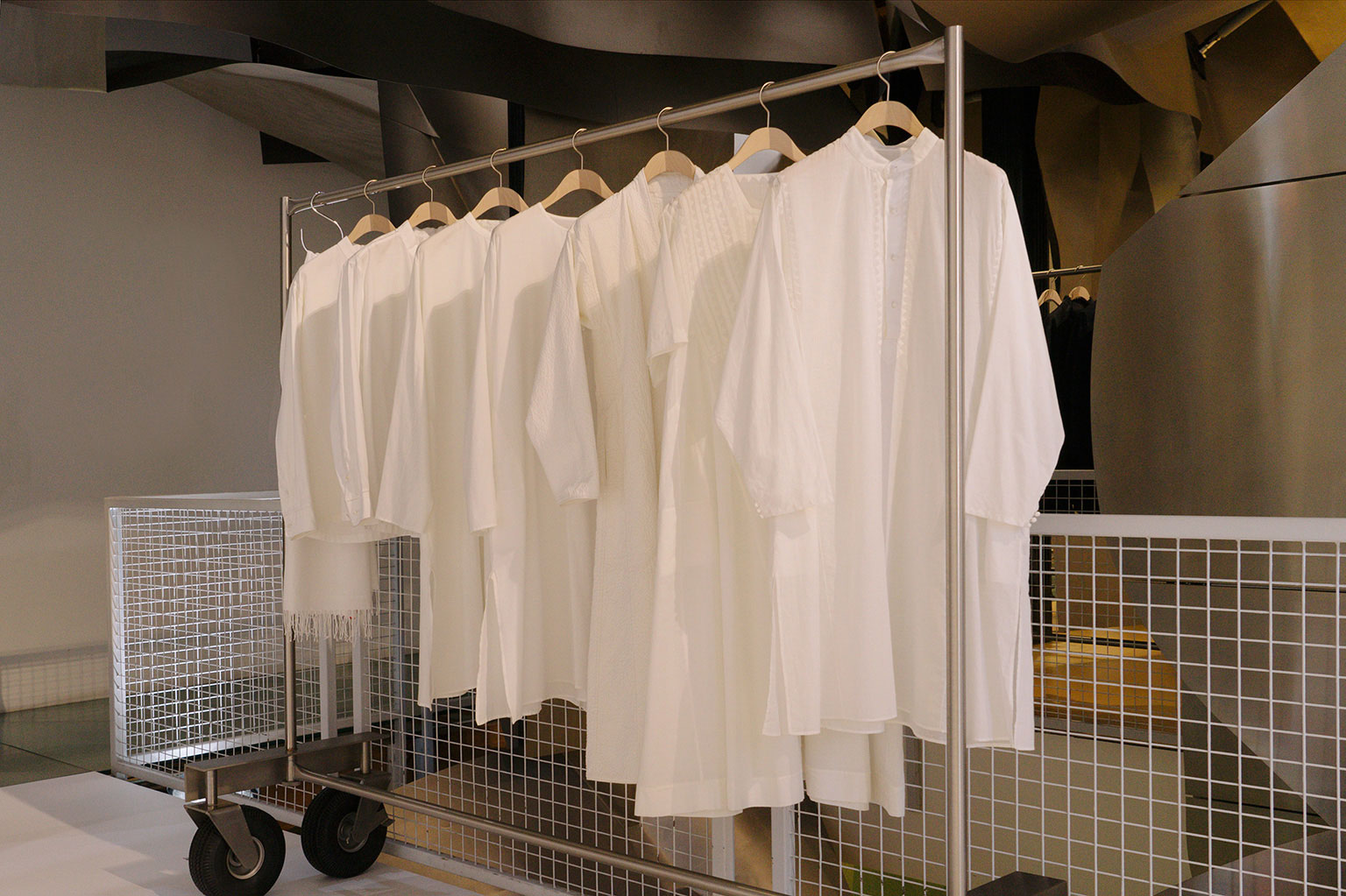

Khadi
Khadi, derived from khaddar, is a hand spun and woven natural fibre cloth coined in 1918 by Mahatma Gandhi during freedom struggle of the Indian subcontinent, ‘Khadi’ term is used throughout India, Pakistan and Bangladesh. The first piece of the hand-woven cloth was manufactured in the Sabarmati Ashram during 1917-18. The coarseness of the cloth led Gandhi to call it ‘khadi’. The cloth is usually hand spun and woven from cotton. However, it may also include silk or wool, which are all spun into yarn on a spinning wheel called a charkha. It is a versatile fabric, cool in summer and warm in winter. In order to improve its looks, khādī/khaddar is sometimes starched to give it a stiffer feel. It is widely accepted in various fashion circles. Popular dresses are made using khadi cloth such as dhoti, kurta, and handloom sarees such as Puttapaka Saree, Kotpad Handloom fabrics, Chamba Rumal, Tussar silk etc. Gajam Anjaiah, an Indian master handloom designer and a recipient of the Padma Shri, is known for his innovation and development of tie-dye handloom products along with the Telia Rumal technique of weaving products based on the Ikat process.
History of Khadi
Fernand Braudel, French historian has mentioned that India became world textile leader till 19th century because it started early. Weaving skill existed since Bronze Age period and cotton cultivation and processing began during Indus Valley Civilization period. Greco-Roman merchants imported finer cotton in large quantities to Roman Empire . In medieval times cotton textiles were imported to Rome through “maritime Silk Road”. Arabian-Surat merchants traded cotton textiles to Basra, Baghdad from three areas of Gujarat, the Coromandel Coast and East Coast of India especially the Ganges Valley of Bengal also it arrived Makkah via Hajj pilgrims. To the east, trade reached to China via Java. 14th century Moroccan traveler Ibn Battuta has mentioned Delhi Sultan Muhammad bin Tughluq sending five varieties of cloth to Chinese Yuan king. Such was the fame of these exotic textiles from Indian subcontinent that they have been treasured in repositories of:
* NATIONAL MUSEUM, New Delhi
* NATIONAL MUSEUM, Dhaka
* NATIONAL MUSEUM CHÂTEAU DE MALMAISON, Paris
* VICTORIA AND ALBERT MUSEUM, London
These artifacts were either diplomatic gifts or were purchased from East India Company EIC or smuggled, such is their uniqueness that they are still displayed along with gems and jewellery in world class museums. By 1830, Great Britain became world leader in Cotton textile displacing India which completely forgot its legacy as if it never existed. Why and how it happened were outcomes of Calico Acts, Imperialism and Industrial Revolution. Had there been a free India, they would have resisted and once blooming textile centers became ghost towns.
East India Company allowed first cotton mill to be opened in 1818 in Calcutta which was a failure. The second cotton mill’s permission was obtained by KGN Daber in 1854 and was named Bombay Spinning and Weaving Company thereafter Shahpur mill in 1861 and Calico mill in 1863 were opened in Ahmedabad.
After First Indian War of Independence in 1857, domestic textile production by mill or by traditional methods declined to its lowest levels and then ‘Khadi’ emerged as “silent economic revolution” by an outcome of a long and laborious evolutionary process.
American Civil War (1861-1865) caused raw cotton crisis in Cottonopolis Britain. Indian cotton at cheap prices was sourced for them as textile industry didn’t exist in India and hand spinning was a dying art. During Victorian rule (1837-1901) of colonial era 47 mills existed in 1870s but still Indians were buying clothes at an artificially inflated price, since the colonial government exported the raw materials for cloth to British fabric mills, then re-imported the finished cloth to India. In Edwardian era(1901-1914) Swadeshi movement of boycotting foreign cloth remained prominent. During the first two decades of the twentieth Century it was backed by Nationalist politicians and Indian mill owners.
Mohandas Gandhi, touched by the plight of farmers at Champaran Satyagraha and Kheda Satyagrah focused the Swadeshi movement on hand spinning and quoted: “It is the immediately practicable supplementary occupation that can be offered to vast mass of the population that is starving or half fed in consequence of abject poverty and enforced labour for nearly half the year”.
In 1922, Gandhi asserted Indian National Congress (INC) to start Khadi Department for spinning activities. In 1924, due to huge work a semi-independent body All India Khadi Board (AIKB) was formed which liasoned with INC Khadi Department at provincial and district levels. In 1925, All India Spinner Association (AISA) was formed comprising Khadi Department and AIKB. Mahatma Gandhi was the founder of AISA, later Jwaharlal Nehru and Rajinder Prashad remained in its executive board. He made it obligatory for all members of the Indian National Congress to spin cotton themselves and to pay their dues in yarn. Mahatma Gandhi collected large sums of money to create grass-root level khadi institutions to encourage spinning and weaving which were certified by AISA. This was called the ‘khaddar’ or ‘Khadi’ movement. Handspun yarn was expensive and of poor quality and weavers preferred yarn produced by mills because it was more robust and consistent in quality. Gandhi argued that the mill owners would deny handloom weavers an opportunity to buy yarn because they would prefer to create a monopoly for their own cloth. When some people complained about the costliness of khadi to Mahatma Gandhi, he started wearing only dhoti though he used wool shawls when it got cold. Some were able to make a reasonable living by using high quality mill yarn and catering to the luxury market. Mahatma Gandhi tried to put an end to this practice. He even threatened to give up khadi altogether if he didn’t get his way. However, since the weavers would have starved if they listened to Gandhi, nothing came of this threat. In 1919 Mahatma Gandhi himself started spinning at Mani Bhawan Mumbai and encouraging others to do so. He invented Patti Charkha, using a double-wheel design to increase speed and control, while it reduced size. It represented probably the first conscious use of the principle of “intermediate technology.” Later by 1946 when huge funds were being spent on development for more productive charkhas, he recommended takli over charkha.
The freedom struggle revolved around the use of khādī fabrics and the dumping of foreign-made clothes.In 1921 chakri (spinning wheel) became the symbol of the Indian flag.
The movement for Khadi began in 1918. The movement was marked with its own changing dynamics. While initially, a clear emphasis could be seen on using Khadi as a medicine to the masses ridden with poverty due to economic stagnation, from 1934 onwards the fabric became something that the village people could use for themselves. It was no longer seen only as a commodity for sale to bring economic prosperity. The meaning became more humble. In 1942-43, right after coming out of the prison, his ideology behind Khadi became that of making the fabric useful for the villagers themselves. His ideas came out clearly by 1944, when he left no stone unturned to bring this change into effect.
Mahatma Gandhi began promoting the spinning of khadi for rural self-employment and self-reliance (instead of mill manufactured) in the 1920s, thus making khadi an integral part and an icon of the Swadeshi movement.
Gandhi Ashram Amritsar opened its extension branch in Srinagar. A Chinar tree was planted at Pampore where Mahatma spinned charkha. It later became center of AISA nowadays PMTC-KVIC. Gandhi Bhawan Jammu, adjoining Secretariat was founded where he gave his speech in Parade Ground Jammu.


