



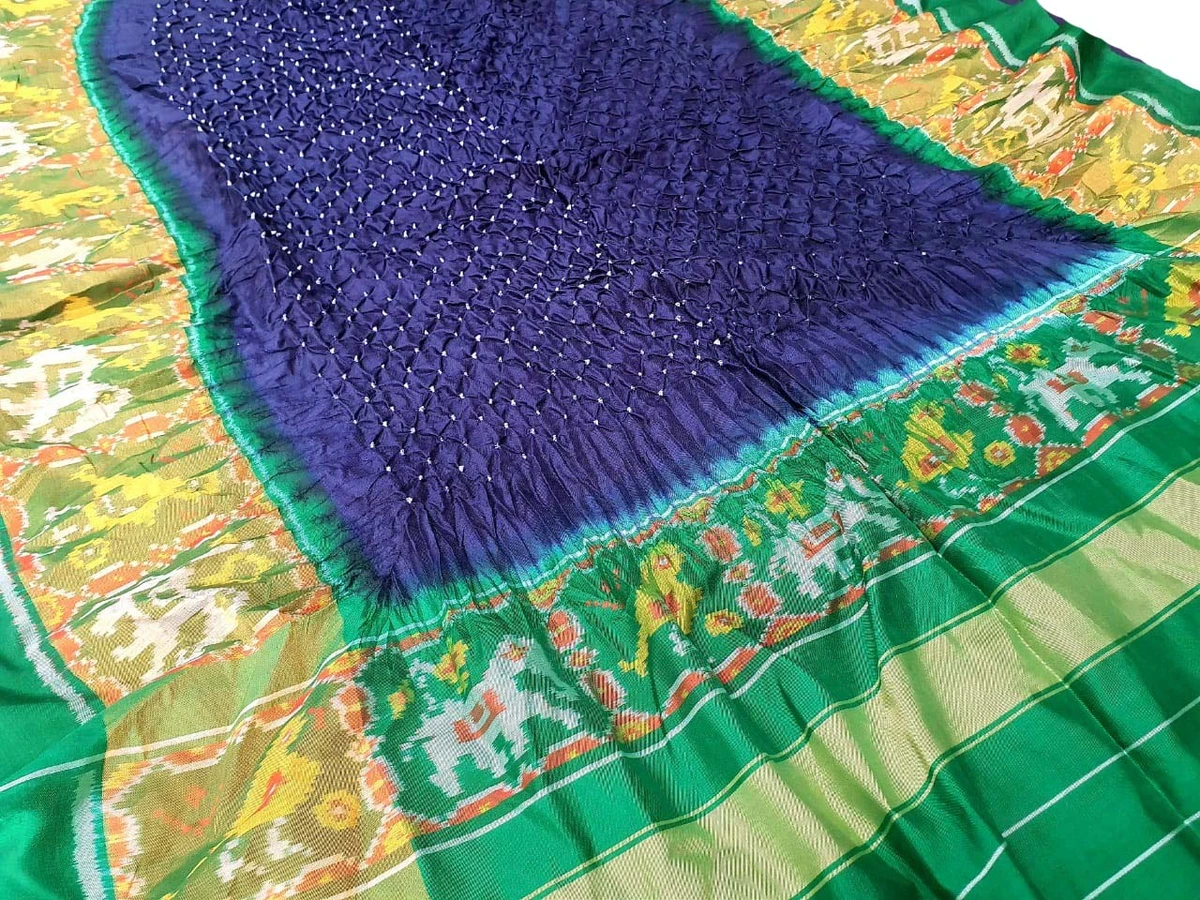

Single Ikat
Ikat (in Indonesian languages means “bind”) is a dyeing technique originated from Indonesia used to pattern textiles that employs resist dyeing on the yarns prior to dyeing and weaving the fabric.
In ikat, the resist is formed by binding individual yarns or bundles of yarns with a tight wrapping applied in the desired pattern. The yarns are then dyed. The bindings may then be altered to create a new pattern and the yarns dyed again with another colour. This process may be repeated multiple times to produce elaborate, multicolored patterns. When the dyeing is finished all the bindings are removed and the yarns are woven into cloth. In other resist-dyeing techniques such as tie-dye and batik the resist is applied to the woven cloth, whereas in ikat the resist is applied to the yarns before they are woven into cloth. Because the surface design is created in the yarns rather than on the finished cloth, in ikat both fabric faces are patterned.
A characteristic of ikat textiles is an apparent “blurriness” to the design. The blurriness is a result of the extreme difficulty the weaver has lining up the dyed yarns so that the pattern comes out perfectly in the finished cloth. The blurriness can be reduced by using finer yarns or by the skill of the craftsperson. Ikats with little blurriness, multiple colours and complicated patterns are more difficult to create and therefore often more expensive. However, the blurriness that is so characteristic of ikat is often prized by textile collectors.
Ikat is produced in many traditional textile centres around the world, including India to Central Asia, Southeast Asia, Japan (where it is called kasuri), Africa, and Latin America. Double ikats—in which both the warp and weft yarns are tied and dyed before being woven into a single textile—are relatively rare because of the intensive skilled labour required to produce them.
Etymology
Ikat is an Indonesian word, which depending on context, can be the nouns: cord, thread, knot, or bundle, also the finished ikat fabric, as well as the verbs “to tie” or “to bind”. While the term ikatan is a noun for bond or tie. It has a direct etymological relation to Japanese of the same word, and also various Indonesian languages from Sumatra, Borneo, Java, Bali, Sulawesi, Sumba, Flores and Timor. Thus, the name of the finished ikat woven fabric originates from the tali (threads, ropes) being ikat (tied, bound, knotted) before they are being put in celupan (dyed by way of dipping), then berjalin (woven, intertwined) resulting in a berjalin ikat- reduced to ikat.
The introduction of the term ikat into European language is attributed to Rouffaer. Ikat is now a generic English loanword used to describe the process and the cloth itself regardless of where the fabric was produced or how it is patterned.
In Indonesian, the plural of ikat remains ikat. While in English, a suffix plural ‘s’ is commonly added, as in ikats. However, these term are interchangeably used and correct.
History
The term “ikat” has Indonesian and Malay origin, and it was introduced into European textile vocabulary back in the early 20th century, when Dutch scholars begin to study the rich textile traditions of the Dutch East Indies archipelago.
Some parts of Asia demonstrate strong ikat traditions which suggest its possible origin; whether they are Maritime Southeast Asia (Dutch East Indies archipelago), the Indian subcontinent and Central Asia. However, it probably developed in several different locations independently.
Uyghurs call it atlas and use it only for woman’s clothing. The historical record indicates that there were 27 types of atlas during Qing Chinese occupation. Now there are only four types of Uyghur atlas remaining: qara-atlas, a black ikat used for older women’s clothing; khoja’e-atlas, a yellow, blue, or purple ikat used for married women; qizil-atlas, a red ikat used for girls; and Yarkent-atlas, a khan or royal atlas.
Yarkent-atlas has more diverse styles; during the Yarkent Khanate (1514–1705), there were ten different styles of Yarkent-atlas.


